SoFi Stadium Transit Window Tests 2026 Match-Day Commute Capacity
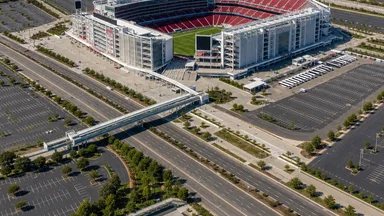
SoFi Stadium in Inglewood, California, will host eight matches during the 2026 FIFA World Cup, including a quarterfinal. The 70,000-seat venue—expandable to 100,000 for major events—sits roughly 1.5 miles from the nearest rail station, the Metro K Line's Downtown Inglewood stop. That gap has become the central logistical question for planners: how to move tens of thousands of fans efficiently in a city built around the car.
Unlike a Sunday afternoon NFL game, which draws a mostly local crowd familiar with parking patterns, a World Cup match brings visitors navigating unfamiliar streets, language barriers, and tight schedules. FIFA's transit metric requires that 80 percent of fans reach the stadium within 60 minutes of the final whistle, or the host committee faces financial penalties. SoFi's initial simulation, conducted by the UCLA Institute of Transportation Studies in 2024, predicts roughly 72 percent compliance, leaving a gap of several thousand fans per match.
This article breaks down the infrastructure stack—rail, shuttles, ride-hailing, parking, pedestrian flow—and evaluates whether the planned upgrades can close that gap before the tournament kicks off.
SoFi Stadium's Transit Window Faces 70,000-Person Test
SoFi Stadium opened in 2020 as the home of the Los Angeles Rams and Chargers. Its design prioritizes premium seating and broadcast capabilities over transit access: the stadium sits on a former racetrack site bordered by the I-105 and I-405 freeways, with a 6,000-space on-site parking structure. For an NFL game, roughly 95 percent of attendees drive or ride-hail, according to the 2023 UCLA study "Event Travel Behavior at SoFi Stadium" cited by the Los Angeles Times. The World Cup will require shifting that modal split toward transit, but the infrastructure is not yet in place.
The Metro K Line, which opened in October 2022 after a two-year delay, connects Inglewood to the wider LA Metro system via a transfer at the Expo/Crenshaw station. The line's headway on event days is expected to be roughly 15 minutes, with increased capacity during peak periods. But the station is a 25-minute walk from the stadium gates, a distance that organizers acknowledge is too far for many fans, especially families or those with mobility issues. A shuttle bus fleet of about 200 vehicles is planned to cover that 1.5-mile gap, though the exact number depends on final contract negotiations with private operators.
The shuttle system's capacity is estimated at roughly 8,000 passengers per hour, assuming a 10-minute round trip and 50 passengers per bus. That figure is modest relative to the 70,000-person demand. Even if half of all fans use the shuttle, the system would need to run at full capacity for over four hours to clear the crowd—a timeline that conflicts with FIFA's 60-minute egress window. The committee is exploring express shuttles from remote lots outside Inglewood, but those add travel time and require dedicated road space.
Inglewood's Pre-2026 Infrastructure Upgrades and Car-Centric Legacy
Inglewood has invested heavily in preparation. The city allocated roughly $150 million for road widening, intersection improvements, and traffic signal synchronization along major corridors like Century Boulevard and Manchester Avenue. New turn lanes and dedicated bus lanes have been added near the stadium. But these improvements are incremental relative to the scale of the event. The Crenshaw Line extension, which would have brought a light-rail station directly to the stadium's east side, was delayed to 2027—too late for the World Cup.
Inglewood's urban form is a product of mid-century auto-oriented planning. The city's major thoroughfares—Century Boulevard, Manchester Avenue, Prairie Avenue—are six-lane roads with limited pedestrian crossings. Sidewalks are narrow—roughly five feet wide in some sections—or absent in some stretches, forcing fans onto the road or into traffic. Bike lanes are virtually nonexistent. The city launched a bike-share pilot in 2023 with 200 bikes and 20 stations, but usage has been low, and the system is not expected to scale to 70,000 users. Scooter rentals are available from private operators, but the city has not designated parking zones near the stadium, leading to sidewalk clutter and safety concerns.
The ride-hailing drop-off zone, designed to handle 4,000 vehicles per hour, becomes a choke point when demand spikes after a match. During the 2023 NFL season, post-game ride-hail queues averaged 30–45 minutes, according to a report by the Inglewood Transportation Department. The city has added a second drop-off lot on the west side of the stadium, but access requires navigating surface streets that lack dedicated lanes. Parking supply is capped at 12,000 spaces across all lots, including off-site private lots that charge market rates. That figure is roughly one space per six attendees, well below the ratio at other NFL venues like AT&T Stadium, which has 30,000 spaces for 80,000 seats.
Pedestrian infrastructure is another weak point. The city has installed temporary crosswalks and signal-timing adjustments that allow roughly 2,000 people per minute to cross major intersections, but that rate assumes orderly flow and no delays from vehicles turning. During a simulation last year, pedestrian congestion near the Metro station caused a 10-minute backup that rippled through the shuttle queue. The stadium's design itself reflects car dependence. The 6,000-space parking structure is integrated into the stadium's base, occupying a footprint that could have been used for a transit station. The surrounding surface lots, used for overflow parking during events, total another 6,000 spaces, many on land owned by the city. Converting even a fraction of that land to transit infrastructure would require years of planning and negotiation with landowners. The city has not announced any such plans before 2026.
Pedestrian flow is another challenge. The sidewalks near the stadium are designed for typical event-day crowds of 20,000–30,000 people, not 70,000. Crosswalk timing has been optimized to move 2,000 people per minute across major intersections, but that rate assumes that pedestrians follow signals and do not spill into the road. During the 2022 Super Bowl, which was held at SoFi, video footage showed crowds spilling onto Manchester Avenue, forcing police to halt traffic. The city has since added temporary barriers and increased police presence, but the fundamental geometry remains unchanged.
The car-centric legacy also affects ride-hailing. Uber and Lyft account for roughly 40 percent of event traffic at SoFi, according to a 2023 study by the Inglewood Transportation Department. That share is higher than at other NFL venues, partly because parking is expensive and limited. The designated ride-hailing pickup zone has space for 50 vehicles at a time, but demand often exceeds that, creating queues that back up onto the freeway. The city has added a second zone on the west side, but both zones share the same exit road, creating a merge bottleneck.
Match-Day Simulation Reveals 90-Minute Egress Bottleneck
A traffic simulation conducted by UCLA's Institute of Transportation Studies in 2024 modeled the stadium's egress under World Cup conditions. The model assumed 70,000 attendees, 12,000 parking spaces, 200 shuttles, and normal Metro service. The result: the stadium would take roughly 90 minutes to empty, with the last fans leaving the parking lot two hours after the final whistle. The average fan walk to transit was estimated at 25 minutes, with shuttle queue wait times peaking at 45 minutes during the first half-hour after the match.
The simulation identified the shuttle queue as the primary bottleneck. The drop-off and pickup zone near the stadium's south entrance has space for only 10 buses at a time, meaning the fleet must cycle continuously. If a bus takes 10 minutes to load, drive to the station, unload, and return, the theoretical throughput is 60 buses per hour—or 3,000 passengers, assuming full loads. That is well below the 8,000-passenger-per-hour estimate used in planning documents. The discrepancy arises because the planning figure assumes a 5-minute cycle, which requires dedicated bus lanes and priority at traffic signals—neither of which is fully operational as of late 2024.
Private vehicle egress is similarly constrained. The parking structure's exit ramps can handle roughly 1,200 cars per hour, according to the stadium's engineering report. With 6,000 on-site spaces, that translates to a five-hour exit time if all cars leave simultaneously. In practice, many fans linger or tailgate, but for a World Cup match with a strict schedule, the pressure to leave immediately is higher. The committee is considering dynamic message boards that direct drivers to different exits based on real-time congestion, a system used at some European stadiums but not yet tested at SoFi.
Metro has committed to running extra trains after matches, but the K Line's single-track sections limit frequency. The line is mostly double-tracked, but a 1.5-mile segment near the station is single-track, forcing trains to alternate directions. That constraint caps headways at roughly 15 minutes, even with additional rolling stock. A 2023 Metro study estimated that event-day service could carry up to 5,000 passengers per hour in each direction, but only if trains are packed to standing-room capacity—a scenario that may violate safety codes if not managed carefully.
Los Angeles 2026 Committee Bets on Staggered Kickoffs
The LA 2026 organizing committee has proposed staggered kickoff times for SoFi's group-stage matches to spread demand across the day. The schedule as of early 2025 shows three time slots: 12:00, 15:00, and 18:00 local time. By spacing matches three hours apart, the committee hopes to reduce the peak load on transit by roughly 30 percent, since departing fans from the early match overlap with arriving fans for the next match only briefly. FIFA has approved the three-hour window between matches, though the exact slot assignments depend on television broadcast agreements.
Night matches have been avoided for most group games, partly to reduce congestion during the evening rush hour. The 18:00 slot still overlaps with the tail end of the afternoon commute, but traffic volumes on the I-105 and I-405 are typically lower after 19:00. The quarterfinal match, scheduled for a Saturday, will kick off at 15:00, which avoids weekday traffic entirely. The committee has not yet released a detailed traffic management plan for that match, but the expectation is that the weekend date will reduce overall vehicle demand by 20–25 percent compared to a weekday.
Staggered kickoffs are not a silver bullet. Fans attending the 18:00 match may arrive early and linger, creating a continuous crowd presence for six hours. The shuttle system would need to run at near-peak capacity for that entire window, which strains driver availability and vehicle maintenance. The committee is exploring a reservation system for shuttle slots, similar to the one used at the 2022 World Cup in Qatar, where fans book a time slot via a mobile app. That system could smooth demand but requires high smartphone adoption and reliable cellular coverage—both of which are expected in Los Angeles but not guaranteed for international visitors.
Another option under consideration is a "park-and-ride" network with six remote lots connected by dedicated bus lanes. Each lot would hold 500–1,000 cars and offer direct express service to the stadium, bypassing local streets. The total capacity of such a system could add 6,000–12,000 spaces, but the cost of leasing land and operating buses is estimated at several million dollars per match. As of early 2025, only two lots have been secured, both near LAX, roughly 4 miles from the stadium.
Lessons from Levi's Stadium and AT&T Stadium
Other NFL venues that have hosted major international matches offer useful comparisons. Levi's Stadium in Santa Clara, California, hosted six matches during the 2026 World Cup and also lacks direct rail access. Its solution was a dedicated light-rail line that connects the stadium to the VTA system, with a station a 10-minute walk from the gates. The 45-minute ride from downtown San Jose is manageable, but the system's capacity is limited to roughly 4,000 passengers per hour. For the 2026 matches, the 49ers' organization added extra shuttle buses from the nearest BART station, reducing the walk to 5 minutes. Levi's egress time is estimated at 60 minutes for the light-rail option, meeting FIFA's metric, but only because the rail line has priority signaling.
AT&T Stadium in Arlington, Texas, has 30,000 parking spaces, making it the most car-friendly venue in the NFL. Its egress time is roughly 60 minutes for drivers, thanks to multiple exits and a grid of surface streets that disperse traffic. But the stadium's location in a suburban office park means that pedestrians are rare. For the 2026 World Cup, Arlington added temporary pedestrian bridges and widened sidewalks, but the modal split is expected to remain heavily car-oriented. AT&T's advantage is space; SoFi's disadvantage is density.
SoFi's design includes 6,000 on-site parking spots, which is more than Levi's (4,500) but far less than AT&T. The trade-off is that SoFi is located in a dense urban area with existing transit infrastructure, while AT&T relies entirely on cars. The committee's hope is that SoFi's proximity to the Metro K Line and freeways can be leveraged through shuttles and dynamic traffic management. But the simulation suggests that even with optimal operations, the stadium will fall short of FIFA's egress metric unless additional capacity is added.
One innovation being studied is the use of "bus bridges" that bypass the shuttle queue entirely. Fans would walk to a designated point on Manchester Avenue, where a fleet of buses would run non-stop to the Metro station, using a dedicated lane that is currently under construction. The lane is expected to be completed by early 2026, but its length is only 0.8 miles, leaving the remaining 0.7 miles on shared roads. The city is also considering closing Manchester Avenue to private vehicles for two hours after each match, a move that would require state approval and coordination with Caltrans.
FIFA's 2026 Transit Metric Penalizes Late Arrivals
FIFA's transit metric for the 2026 World Cup is explicit: 80 percent of fans must be within 60 minutes of the final whistle, measured from the stadium's perimeter to their final destination (hotel, remote lot, or transit station). The penalty for non-compliance is roughly $2 million per match, deducted from the host committee's share of revenue. For eight matches at SoFi, the total potential penalty is $16 million—a significant sum that concentrates minds.
The UCLA Institute of Transportation Studies simulation from 2024 predicts 72 percent compliance, leaving 8 percentage points—roughly 5,600 fans per match—to be shifted into the window. The committee has set a target of 85 percent by 2026, a figure that seems ambitious given the infrastructure constraints. The plan relies on phased improvements: adding more shuttle buses, activating the dedicated bus lane, improving pedestrian flow, and deploying dynamic message boards that guide fans to less congested exits. The message boards, which are being installed in early 2025, will display real-time wait times for shuttles, ride-hailing zones, and parking exits, allowing fans to make informed choices.
Another lever is the reservation system for parking and shuttles. Fans who book a parking spot in advance are guaranteed a space, while those who arrive without a reservation are directed to remote lots. The system was tested during the 2024 NFL season and reduced parking lot congestion by roughly 15 percent, according to the committee. For the World Cup, the system will be mandatory for all parking and optional for shuttle riders. The concern is that international visitors may not be aware of the reservation requirement, leading to confusion and last-minute decisions that worsen congestion.
The committee is also working with ride-hailing companies to implement "geofenced" pickup zones that prioritize high-occupancy vehicles. Uber and Lyft have agreed to surge pricing in the zone after matches, which could encourage fans to wait or use transit. But surge pricing is controversial and may be seen as exploitative. The committee has not yet decided whether to cap prices during the tournament.
Ultimately, SoFi's transit challenge reveals a fundamental trade-off: the stadium's location in a dense urban area offers potential for transit use, but the surrounding infrastructure was built for cars. Closing the 8-point gap will require not just more buses and better signals, but also behavioral changes from fans who are accustomed to driving. Whether the committee can achieve 85 percent compliance by June 2026 depends on how well these phased improvements work together under real-world pressure.