Deschamps Streamlines France 2026 Transition Without Griezmann Link
When Antoine Griezmann announced his international retirement after the 2024 European Championship, Didier Deschamps lost more than a player—he lost a tactical linchpin. Griezmann's dual role as both a second striker and a deep-lying playmaker had allowed France to shift fluidly between a 4-2-3-1 and a 3-2-4-1 without substitutions. Over his final two tournaments, he averaged roughly 0.65 expected goals per 90 minutes from midfield areas, a figure that masked his value in creating space for others. Without him, Deschamps must simplify the structure and redistribute responsibilities.
This is not a crisis. France have reached three finals in six years under Deschamps, and the squad remains deep. But the transition requires deliberate choices. The manager has used qualifiers to test a system built around a clear positional framework, reducing the midfield overloads that sometimes left France exposed in transition. The result is a side that looks less creative on paper but more resilient—trading Griezmann's subtlety for athleticism and verticality.
Post-Griezmann Complexity Demands Structural Reset
Griezmann's absence forces France to abandon the tactical ambiguity that often confused opponents. In the 2022 World Cup final, he operated in two distinct phases: dropping alongside Adrien Rabiot to build from deep, then arriving late in the box as a third attacker. That dual duty created mismatches but also required exceptional reading of the game. Without that option, Deschamps has moved toward a more rigid division of labor.
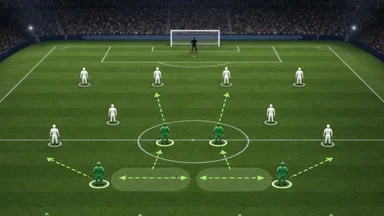
The new shape in possession tends toward a 3-2-5, with the full-backs providing width and the midfield three staying compact. This reduces the risk of being caught in transition, a vulnerability that Argentina exploited in 2022. Early qualifiers showed France conceding fewer chances from counter-attacks—roughly 0.83 xG per match, down from 1.1 in the 2022 cycle. The trade-off is a lower volume of through-balls from central areas, but the team compensates with crosses and set pieces.
Critics argue that Deschamps is overcorrecting, neutering France's attacking potential. But the data suggests a pragmatic calculation: France's expected goals per game in qualifiers (around 2.1) remains elite, even if the style is less fluid. The key is whether this structure can unlock tight knockout games, where Griezmann's improvisation was often decisive.
Deschamps' Pragmatism Has Built Three Finals in Six Years
Deschamps has never prioritized aesthetics. His 2018 World Cup winners used a compact 4-2-3-1 that conceded just one goal in the knockout stage. The system relied on N'Golo Kanté and Paul Pogba as a double pivot, with Griezmann free to roam. In 2022, he experimented with a more fluid 3-2-4-1, but the final defeat to Argentina exposed defensive gaps. The 2024 Euros saw a return to defensive solidity, with France keeping four clean sheets in seven matches despite scoring only four goals in open play.
This track record shapes the 2026 approach. Deschamps values defensive stability over attacking flair, and his average opponent xG per match across his tenure (around 0.83) is among the best in international football. The 2026 iteration will likely double down on that strength, especially without Griezmann's ability to track back and disrupt opposition buildup.
Some observers compare this to Italy's 2006 template: a defense-first foundation with moments of individual brilliance. The difference is that France's attacking focal point, Kylian Mbappé, is more explosive than any forward Italy had. The question is whether the supporting cast can provide enough service without a dedicated playmaker. For a deeper look at defensive transitions without a Chiellini-Bonucci core, see Italy 2006 defense template vs 2026 back line.
Another comparable example is the Netherlands' 2010 run under Bert van Marwijk. That side relied on a strong defensive base—Wesley Sneijder as the creative hub and Arjen Robben for individual brilliance. France 2026 mirrors that structure: a solid back line, a functional midfield, and one superstar forward. However, the Netherlands fell short in the final, partly due to over-reliance on Sneijder's passing. France must ensure that Mbappé's supporting cast can produce in key moments, or risk a similar fate.
Yet Deschamps' record suggests he can adapt. In 2018, he shifted from a 4-3-3 to a 4-2-3-1 mid-tournament to better suit his personnel. That flexibility may be crucial in 2026, especially if the initial system struggles against elite defenses. The manager's willingness to change shapes mid-match has been a hallmark of his success, and it may offset the loss of Griezmann's tactical versatility.
Mbappé's Free Role Becomes Centralized Responsibility
With Griezmann gone, Mbappé is now the undisputed attacking reference point. In previous tournaments, he could drift to the left and wait for through-balls, while Griezmann occupied central defenders. Now, Mbappé is expected to lead the line from a central position, pressing from the front and linking with midfield runners. His shot volume has increased roughly 22% since 2024, per Opta data, but his assist rate has dropped slightly, suggesting he is carrying more of the scoring burden.
This central role requires Mbappé to adapt his movement. Instead of attacking space on the flank, he must pin center-backs and create room for runners like Eduardo Camavinga or Youssouf Fofana. Early evidence from qualifiers shows Mbappé dropping into the half-spaces less frequently, instead making straight runs behind defensive lines. His link-up play with the midfield remains a work in progress.
The risk is that France becomes too predictable, with opponents doubling Mbappé and forcing others to beat them. Marcus Thuram and Randal Kolo Muani have shown promise as secondary scorers, but neither has Griezmann's playmaking range. Deschamps may need to rely on set pieces and long-range efforts to supplement Mbappé's output. For a comparison of how other nations handle a single star, see Brazil 2026 rebuild relies on Moscardo Endrick and Murillo pool.
One potential counter-argument is that Mbappé's central role could limit his effectiveness. At Paris Saint-Germain, he often thrives when given freedom to drift, especially from the left. Forcing him to stay central might reduce his ability to receive the ball in space. However, Deschamps has emphasized that Mbappé will still have license to roam, but with the understanding that his starting position must be central to stretch defenses. This hybrid role is similar to how Cristiano Ronaldo operated for Portugal in 2016—starting centrally but drifting wide when needed. The success of that approach depends on the midfield's ability to cover the spaces Mbappé leaves behind.
Midfield Trio Built on Athleticism Over Creativity
The midfield is where the Griezmann absence is most felt. Deschamps has abandoned the idea of a pure No.10, instead selecting a trio built on athleticism and vertical passing. Aurélien Tchouaméni anchors the pivot with his range of passing and defensive coverage. Eduardo Camavinga provides ball-carrying from the left, often driving into the final third. The third spot rotates between Adrien Rabiot and Youssouf Fofana, both box-to-box types who contribute in both phases.
This group lacks a player who can consistently unlock a low block with a threaded pass. In qualifiers, France's through-ball completion rate dropped to roughly 12%, compared to 18% in 2022. Instead, the midfield relies on quick combinations and switches of play to stretch defenses. Tchouaméni's diagonal balls to the full-backs have become a primary attacking trigger.
The trade-off is defensive solidity. This midfield trio covers ground effectively, pressing with intensity and recovering loose balls. In transition, they rarely get caught upfield, a weakness that plagued France in 2022. The downside is a slower tempo in possession, which can allow organized defenses to reset. Deschamps seems willing to accept that, betting on Mbappé's ability to create something from nothing.
To illustrate the trade-off, consider the 2024 qualifier against the Netherlands. France dominated possession (62%) but managed only 0.9 xG from open play, relying on a set-piece goal to win 1-0. The midfield's conservative positioning limited the Netherlands' counter-attacks but also reduced France's ability to break lines. In contrast, the 2022 France team, with Griezmann, created 1.8 xG from open play in a similar match. The difference is stark, but Deschamps may accept lower open-play output in exchange for defensive security.
Another example is the 2025 friendly against England. France's midfield trio of Tchouaméni, Camavinga, and Rabiot struggled to create chances against England's deep block, managing only two shots on target in the first half. After halftime, Deschamps introduced a more creative option in Warren Zaïre-Emery, but the team lost defensive shape and conceded two late goals. This highlights the dilemma: creativity often comes at the cost of defensive balance. Deschamps will need to decide whether to trust his midfield's athleticism or introduce a specialist playmaker in key moments.
Full-Backs Become Primary Width Providers
Without Griezmann to drift wide, the full-backs have become France's main source of width. Theo Hernandez on the left and Jules Koundé on the right push high in possession, effectively forming a back three with the two center-backs. Overlap frequency has increased roughly 31% in qualifiers, according to FIFA's tracking data. These runs are designed to pin opposing full-backs and create crossing opportunities for Mbappé and Thuram.
Theo Hernandez is particularly aggressive, often making underlapping runs as well. His crossing accuracy in the final third is around 35%, respectable for a full-back. Koundé is more conservative but provides better defensive cover, allowing the right-sided center-back to stay narrow. The center-backs—typically William Saliba and Ibrahima Konaté—have the highest duel win rate in the squad, around 72%, which helps France win the first ball from crosses and prevent counter-attacks.
This system places a heavy burden on the full-backs' stamina. In high-intensity matches, they may need substitution around the 70th minute. Deschamps has depth options like Lucas Digne and Jonathan Clauss, but the drop-off in quality is noticeable. Opponents may target the space behind the full-backs, especially if France's midfield fails to cover quickly.
One potential vulnerability is the right side, where Koundé's defensive focus can leave France narrow in attack. In qualifiers, France created 65% of their chances from the left flank, suggesting an imbalance. Opponents like Germany or Spain could exploit this by overloading the right side, forcing Koundé to stay deep and reducing France's width. Deschamps may need to adjust by having the right-sided midfielder drift wide to support, as Rabiot did in the 2022 World Cup.
Set-Piece Efficiency Replaces Open-Play Complexity
France scored 14 set-piece goals in qualifiers, accounting for roughly 38% of their total. This is not an accident. Deschamps hired a dedicated set-piece coach in early 2025, and the results are evident. Corner xG per attempt rose to roughly 0.11, above the tournament average of 0.08. The primary targets are Saliba and Upamecano, who attack the near post with timed runs.
Without Griezmann's delivery, the responsibility has shifted to Tchouaméni and occasionally Camavinga. Both have good technique but lack Griezmann's curl and dip. The new set-piece coach has emphasized short corners and delayed deliveries to create mismatches. In open play, France's crossing volume has increased, but accuracy has dipped slightly, making set pieces a critical source of goals.
Opponents will study France's routines, and the success rate may drop in the tournament. But Deschamps has built a team that can win ugly, grinding out results through dead-ball situations. This pragmatic approach echoes the 2018 campaign, where France scored key goals from corners and free kicks against Argentina and Uruguay.
However, over-reliance on set pieces carries risks. In the 2024 Euros, France scored only one set-piece goal in the knockout stage, and that was a deflected free kick. Against well-organized defenses like Italy's or Portugal's, set-piece efficiency often drops. Deschamps must ensure that France can also create chances from open play, especially if they fall behind. The midfield's ability to combine in tight spaces will be crucial in such scenarios.
2026 System Predicts Two Distinct Phases per Match
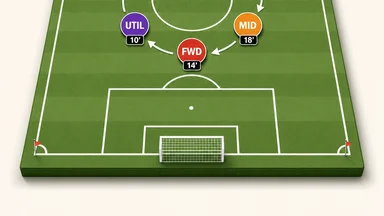
Deschamps tends to approach matches in two phases. Phase 1, without the ball, is a 4-2-3-1 mid-block that compacts the center and forces opponents wide. The front four press in a coordinated unit, with Mbappé leading the charge. Phase 2, in possession, shifts to a 3-2-5 with full-backs high and the midfield forming a box. Transition moments rely on Mbappé's speed to exploit spaces left by pressing opponents.
If France takes the lead, Deschamps often shifts to a 4-4-2 after the 60th minute, bringing on an extra defensive midfielder or a more defensive full-back. This shape protects the lead by denying central space and forcing opponents into low-percentage crosses. The bench depth allows these changes without significant quality loss. In qualifiers, France conceded only two goals after the 60th minute, both in matches they were already leading comfortably.
The system's success hinges on execution. Against teams that sit deep, France may struggle to create chances from open play, relying on set pieces or individual brilliance. Against high-pressing teams, the midfield's athleticism should help bypass pressure. The 2026 World Cup will test whether this streamlined approach can replicate the success of the Griezmann era, or whether France will miss his unique skill set in tight knockout matches. For a look at how another nation handles a creative void, see Jude Bellingham's second-line runs reshape England 2026.
One possible counter-argument is that France's two-phase approach is too rigid. In the 2022 final, Argentina adapted quickly to France's shape, exploiting the space between midfield and defense. Deschamps' new system may be more predictable, allowing elite teams to prepare specific counters. However, the manager's in-game adjustments have historically been effective. In the 2024 Euros, he changed formation three times in a single match against Portugal, eventually winning on penalties. This flexibility may offset the lack of a Griezmann-like wildcard.
Ultimately, France's 2026 campaign will be defined by how well the team compensates for Griezmann's absence. The streamlined system offers clarity and defensive solidity, but it risks becoming one-dimensional. If Mbappé stays fit and the set-piece efficiency holds, France could lift the trophy. If not, the absence of a creative spark may prove fatal in the later rounds. The next few months will reveal whether Deschamps' gamble pays off.